
Charities rose and fell together — what does that mean for policy?
In 2023, the British Academy published Space for Community, a report urging policymakers to invest in social infrastructure — the networks of organisations that hold communities together. Voluntary organisations are a core part of that infrastructure, but how has their presence actually changed over time? And does it vary by place? A new study published in Voluntas (McDonnell, Mohan & Norman, 2026) offers the most comprehensive answer yet, tracking charity density — the number of charities per capita — across 330 local authorities in England and Wales over six census periods from 1971 to 2021.
The most striking finding is how uniform the pattern is. Figure 1 shows predicted growth trajectories by region: every one follows the same arc. Charity density grew rapidly from 1971 to around 2001, then plateaued and began to decline. This holds across the North East, South West, London, Wales — everywhere. The trajectory of voluntary action is not a story about particular places doing well or badly. It is a national pattern.
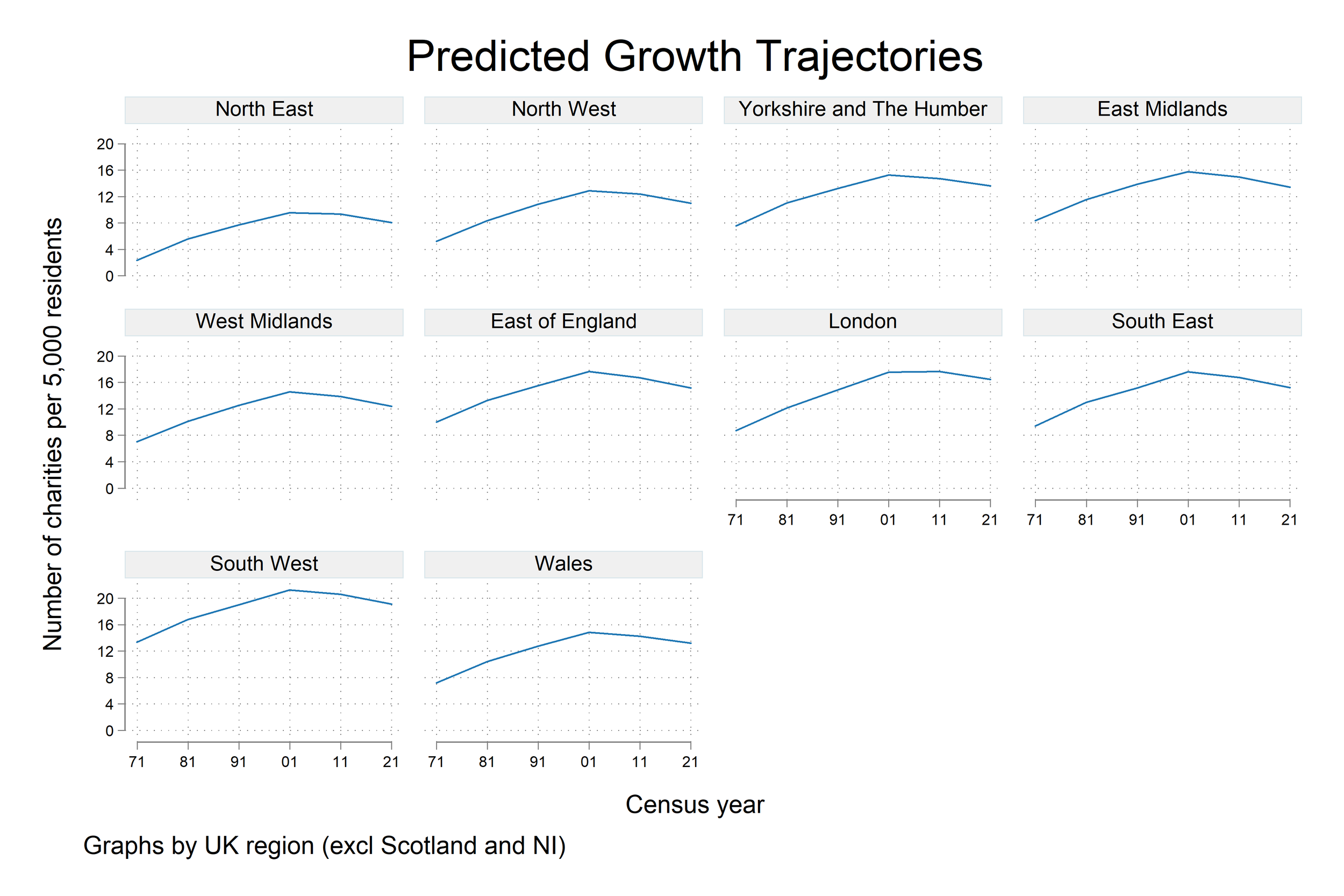
Figure 1: Predicted growth trajectories of charity density by UK region, 1971–2021
But while the shape is shared, the level is not. Figure 2 shows predicted trajectories grouped by deprivation quintile. The least deprived areas (quintile 1) have the highest charity density throughout, peaking at around four charities per 1,000 residents. The middle quintiles have notably fewer. Surprisingly, the most deprived areas (quintile 5) have the second highest density — a U-shaped pattern the authors attribute to the convex relationship between deprivation and charity presence. These level differences are substantial and have endured across fifty years, even as every group followed the same rise-and-decline arc.
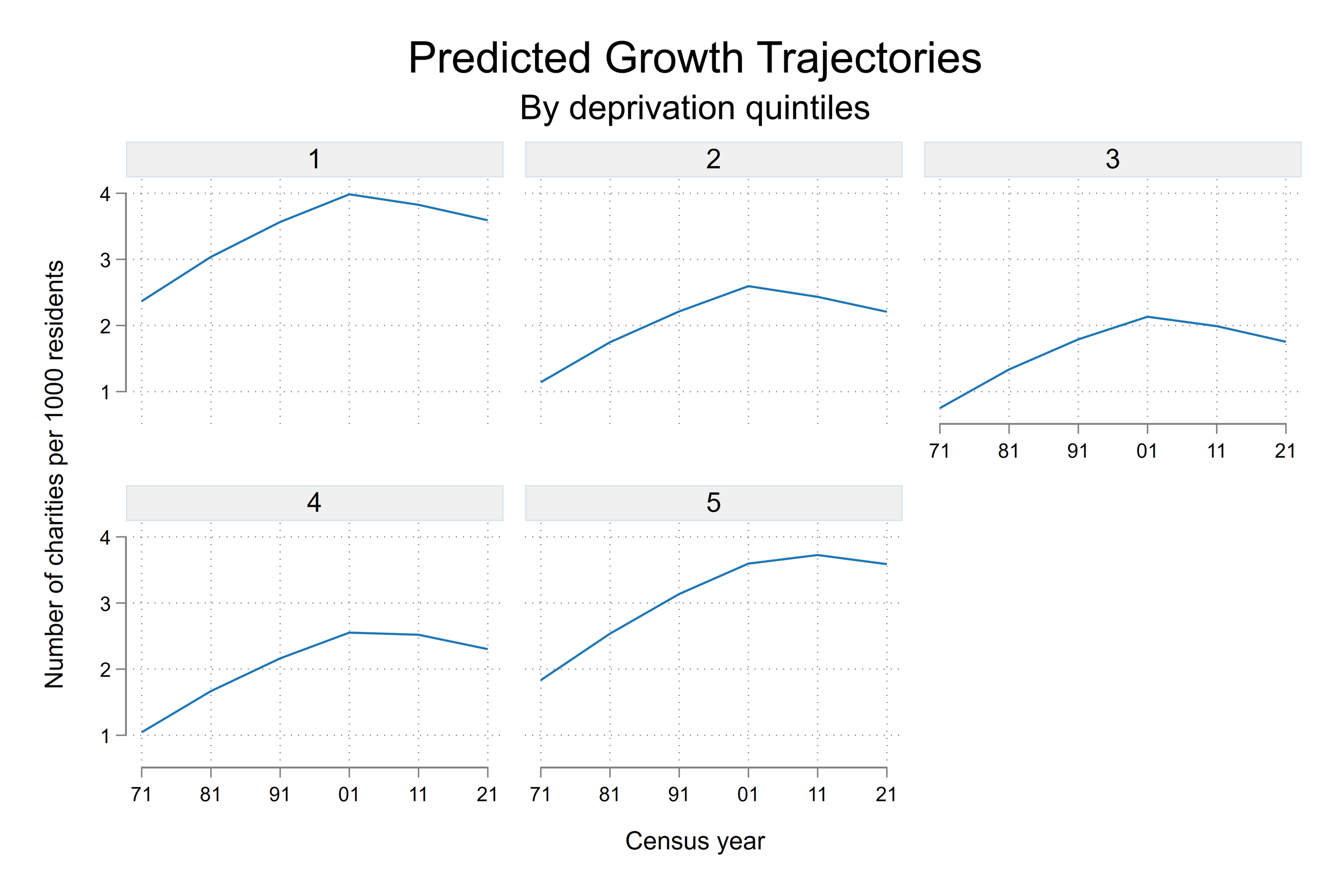
Figure 2: Predicted growth trajectories of charity density by deprivation quintile, 1971–2021
These findings carry a clear policy implication. Because the rise and decline of charity density is driven by national-level forces — economic conditions, funding environments, population change — spatially targeted programmes alone are unlikely to shift it. The study suggests that sustained voluntary action depends more on broad economic stability, ensuring people have the time and resources to support organisations, than on place-specific interventions. The enduring inequality in charity density is a serious challenge, but the evidence points to national social and economic policy as the most important lever. Our future work at Braw Data is examining whether similar patterns hold for other forms of civil society organisation, such as community interest companies and social enterprises.
Read the full open-access article in Voluntas: https://doi.org/10.1017/S0957876526000069